Verdict
If you are building AI agents that need fresh, filtered web data and you are comfortable writing Python, try Perplexity’s Search‑as‑Code. If you rely on fixed‑function search APIs or lack sandboxed code execution, you can skip it for now.
What It Does
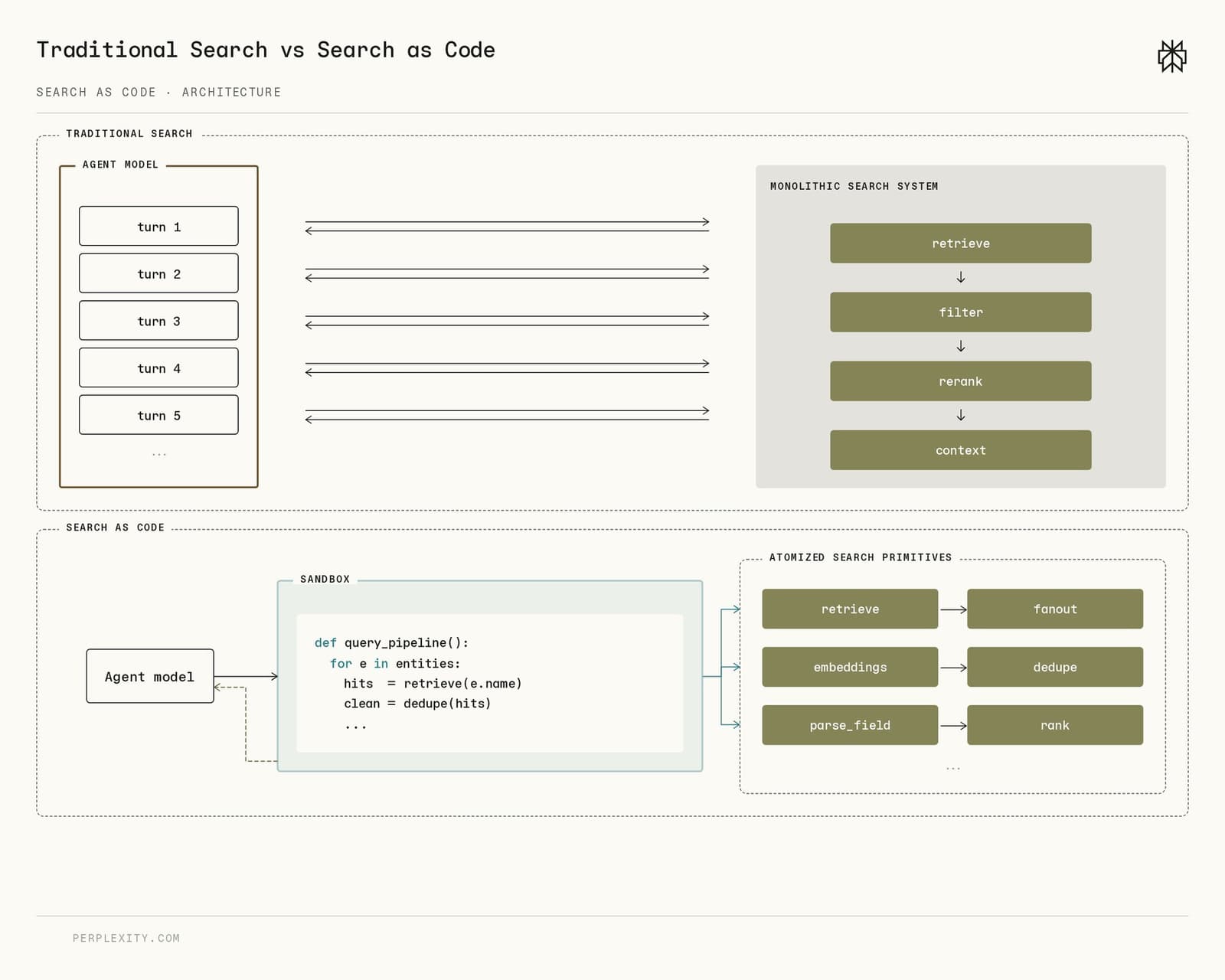
Perplexity has replaced the traditional model of calling a static search API with a programmable “Search as Code” architecture. Instead of sending a query to a black‑box service, the AI model receives a sandbox where it can write its own search routine in Python. Within that sandbox the model can handle filtering, deduplication, and any custom logic it needs before returning results.
The approach lets the agent treat search as just another piece of code it can manipulate, rather than a fixed external call. According to The Decoder, this shift cuts token consumption by up to 85 % and improves performance on key benchmarks compared with leading models from OpenAI and Anthropic.
Best Use Cases
- Dynamic data‑driven agents: When an assistant must retrieve the latest news, prices, or niche information that changes frequently, writing a custom pipeline lets it adapt the query and post‑process results on the fly.
- Complex filtering needs: Scenarios that require multi‑step deduplication, language‑specific ranking, or domain‑specific relevance scoring benefit from being expressed directly in code.
- Cost‑sensitive deployments: Projects that run many search calls can see a dramatic reduction in token usage, which translates to lower API bills.
- Research prototypes: Academics testing new retrieval strategies can experiment by swapping out Python snippets without re‑training the underlying model.
Limits
The sandboxed Python environment introduces a new surface for security and stability concerns. Developers must trust that the sandbox properly isolates execution and that the model does not generate harmful code. The architecture also assumes the user can write and maintain Python search scripts; teams without that skill set may face a steep learning curve.
Perplexity’s announcement focuses on benchmark performance and token savings, but it does not provide detailed latency numbers or pricing tiers. Without that data, organizations must weigh the potential cost benefits against the unknown operational overhead.
Alternatives
Traditional fixed‑function search APIs from OpenAI, Anthropic, or Google remain viable for teams that prefer a plug‑and‑play experience. Those services handle query formulation, result ranking, and safety checks internally, removing the need for custom code.
For enterprises already embedded in cloud ecosystems, OpenAI’s frontier models on AWS offer a managed path with familiar procurement workflows, as noted in OpenAI’s June 1 release. However, those models still rely on the standard API contract rather than a programmable search layer.
Final Recommendation
Perplexity’s Search‑as‑Code opens a practical route for developers who want tighter control over web retrieval while shaving token costs. If your team is comfortable writing sandboxed Python and you need bespoke filtering, give it a try. If you prioritize simplicity, existing fixed APIs may still be the better fit until more operational details—such as latency and pricing—are disclosed.
📎 Related Articles
WebMax Canada: AI Search Visibility Key for Trade Contractors • When AI Search Agents Echo Their Training Instead of Browsing Fresh Data • NVIDIA’s New Physical AI Tools: A Practical Review • Qwen3.7-Plus Review: When Multimodal AI Becomes an Autonomous Engineer • Should You Switch to Google’s AI Mode? A Practical Review • Salt Code Review: Enforcing Security in AI Coding Assistants • MiniMax M3 Review: Open‑Weight Model with 1M‑Token Context • Nvidia RTX Spark Review: Is Local AI on Windows Ready?
Explore related AI topics
AI News Today • AI Tools • Best AI Tools • ChatGPT Prompts • AI Agents