Verdict
If you need a freely available model that can read long documents and handle code snippets while also processing images, give MiniMax M3 a look. If your projects rely on a tightly integrated, vendor‑locked ecosystem or require proven production‑grade benchmarks, you may want to keep searching.
What It Does
According to The Decoder, MiniMax M3 is the first open‑weight model that pairs a one‑million‑token context window with top‑tier coding performance and native multimodality. In practice, the model can ingest massive text streams—think full books or extensive codebases—while also interpreting visual inputs without a separate vision model.
Best Use Cases
- Long‑form code review. Developers can feed an entire repository (or large portions of it) and ask the model to spot bugs, suggest refactors, or generate documentation.
- Document analysis. Researchers handling lengthy reports, legal contracts, or scientific papers can query the model across the whole text without chopping it into pieces.
- Multimodal prototyping. Teams building AI assistants that need to understand screenshots, diagrams, or UI mockups alongside textual instructions can experiment with a single model.
Limits
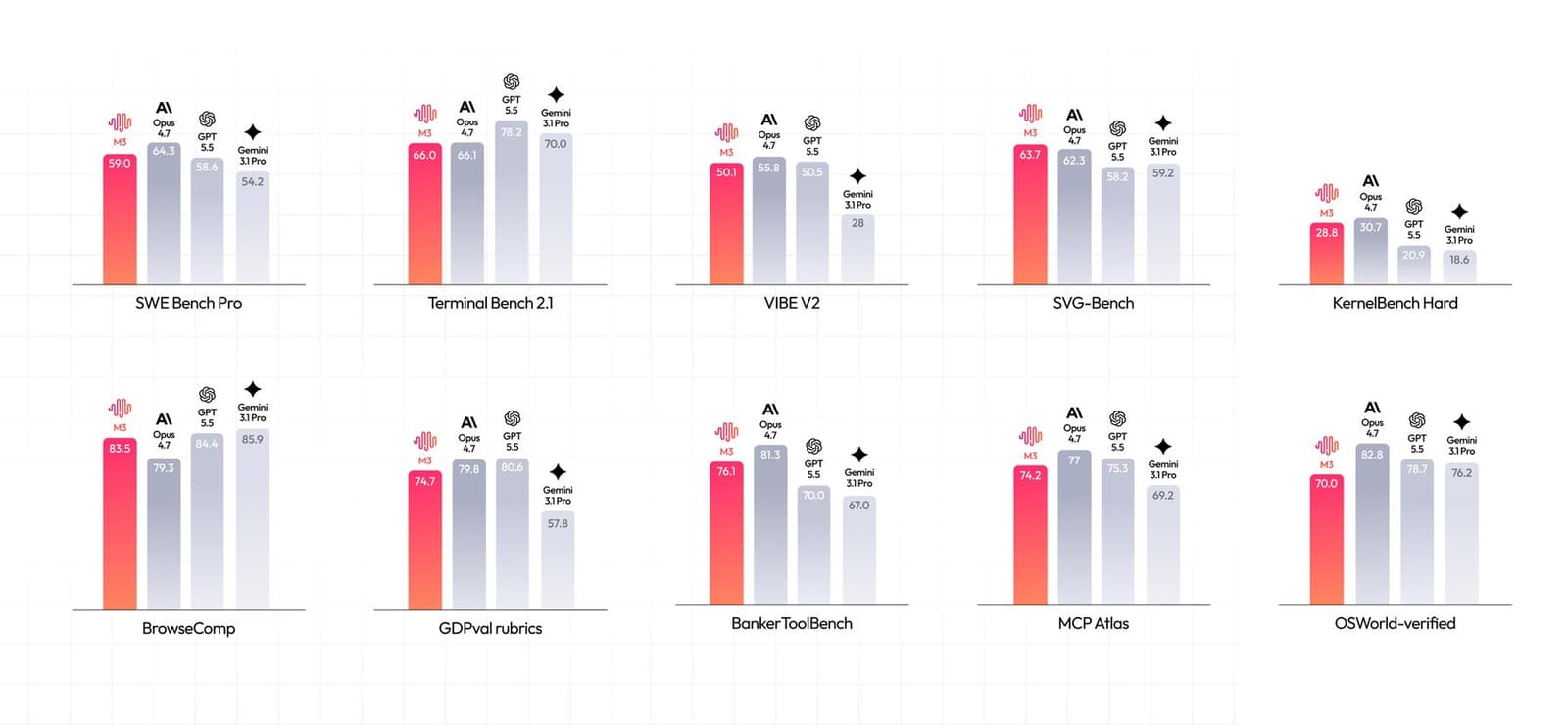
The announcement does not include pricing, performance benchmarks, or availability details beyond the open‑weight claim. Without independent benchmark data, it is hard to compare speed or accuracy against established proprietary models. The model’s resource requirements for a million‑token context are also unclear, which may pose challenges for developers without high‑end GPUs.
Alternatives
For teams that need proven performance metrics, proprietary models from major cloud providers still dominate the market. Open‑weight options with smaller context windows—such as Llama‑3 or Mistral‑Large—offer more documented benchmark results but lack the million‑token reach. NVIDIA’s recent releases (Alpamayo 2 Super and Cosmos 3) focus on robotaxi reasoning and physical AI, which are not direct substitutes for a general‑purpose coding and multimodal model.
Final Recommendation
MiniMax M3 is worth a trial for developers and researchers who value openness and need to work with very long texts or mixed media. Organizations that cannot tolerate uncertainty around performance or hardware costs should evaluate more established models first. Keep an eye on upcoming benchmark releases from MiniMax; they will be the key to deciding whether M3 can move from a promising prototype to a production workhorse.
📎 Related Articles
AgentOps Review: Managing Agentic AI with Amazon Bedrock AgentCore • Nvidia RTX Spark Review: Is Local AI on Windows Ready? • Permissions, Not Model Speed, Hold Back AI Agents • OpenAI Teams Up with Brazil’s Leading Newsrooms • Virgin Atlantic speeds app delivery with Codex • Virgin Atlantic’s Codex‑Powered Sprint Beats Traditional Code Review • Why Permissions, Not Model Power, Are Holding AI Agents Back • Virgin Atlantic Cuts Shipping Time with Codex – Verdict Inside
Explore topic hubs
AI News Today • AI Tools • Best AI Tools • ChatGPT Prompts • AI Agents