Verdict
If you are building tools that need to see, click, and code without human supervision, give Qwen3.7-Plus a serious look. If your work stays purely textual or you require open‑source weights, skip it.
What It Does
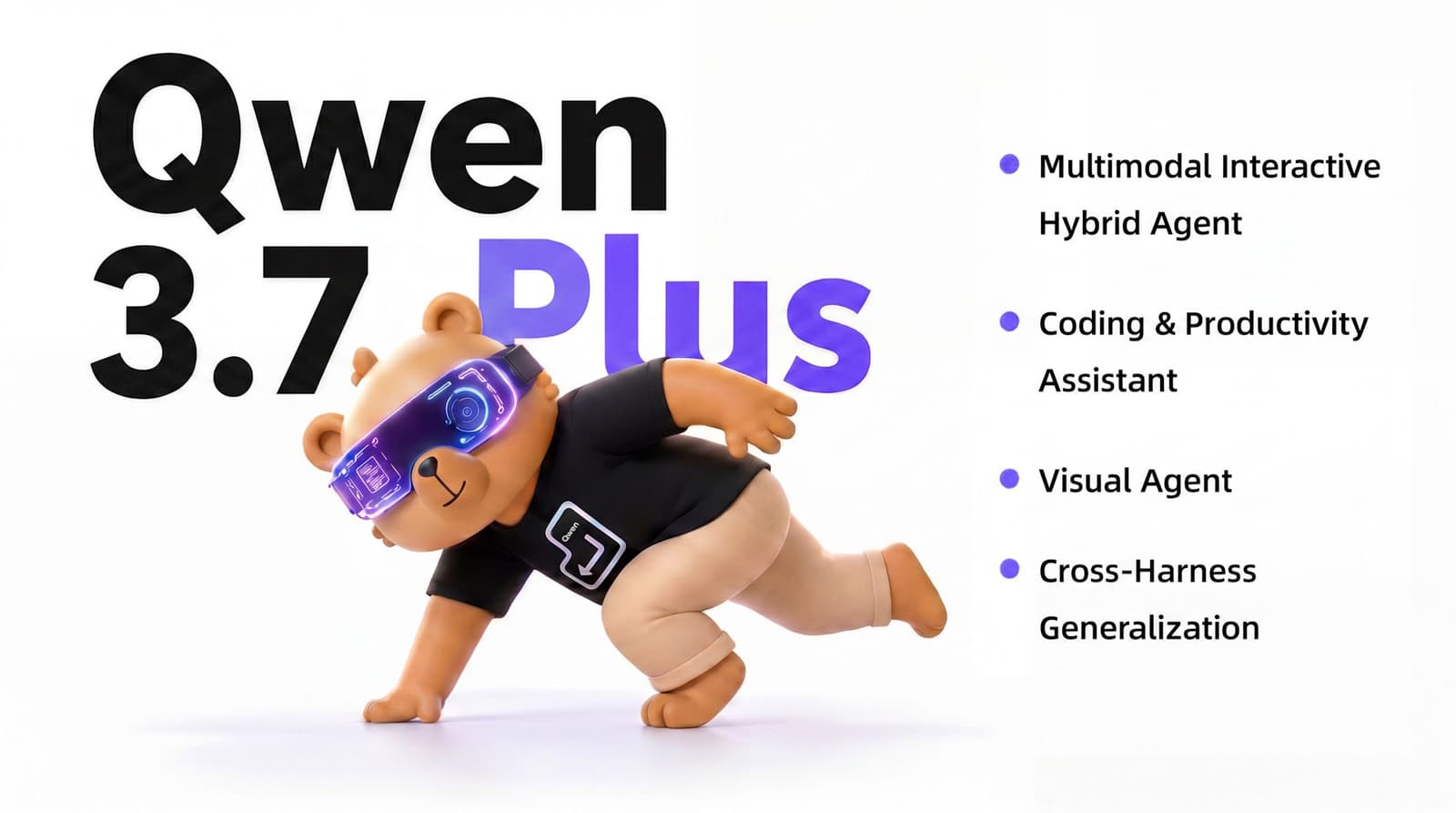
Qwen3.7-Plus is Alibaba’s latest multimodal agent model. According to The Decoder, the model fuses visual perception, graphical‑user‑interface (GUI) manipulation, and code generation into a single loop. In a public demo the model drove an autonomous agent that built a vocabulary‑learning application from scratch, writing more than 10,000 lines of code across roughly 1,000 calls in an eleven‑hour span. The same source notes that Qwen3.7-Plus tops on‑screen understanding in Alibaba’s internal benchmarks, though its overall performance is mixed. The offering is proprietary; weights are not released and pricing details are not fully disclosed.
Best Use Cases
1. End‑to‑end UI‑driven prototyping
Because the model can interpret screen content and issue GUI actions, it excels at tasks that require visual feedback—clicking buttons, dragging elements, or navigating menus—while simultaneously writing the underlying code. Teams that need rapid prototypes of desktop or web tools can let the agent explore a mockup, adjust layout, and generate the corresponding front‑end code without a human in the loop.
2. Automated code generation from visual specs
Designers often hand off mockups or screenshots to engineers. Qwen3.7-Plus can read those images, understand component hierarchy, and produce functional code that matches the visual intent. The vocabulary‑learning app demo demonstrated that the model can sustain a long‑running coding session, suggesting it could be harnessed for converting UI wireframes into production‑ready components.
3. Continuous integration of visual regression testing
In CI pipelines where visual regression failures need to be diagnosed and fixed, an autonomous agent that both perceives the failing UI and patches the code could shrink turnaround time. Qwen3.7-Plus’ ability to loop between perception and code makes it a candidate for such closed‑loop automation.
Limits
The Decoder points out that while Qwen3.7-Plus leads in on‑screen understanding, its broader performance is mixed. That means the model may excel at recognizing UI elements but stumble on more abstract reasoning or non‑visual tasks. The proprietary nature also imposes constraints: developers cannot inspect or fine‑tune the weights, and the lack of open‑source licensing may be a compliance hurdle for some enterprises. Pricing is described only as “well‑bel…”, leaving the exact cost ambiguous.
Another practical limitation is the need for a stable runtime that can feed screen captures back to the model and accept GUI commands. The demo used a custom agent loop; reproducing that environment may require engineering effort that offsets the time saved by the model.
Alternatives
For teams that need an open‑source stack, NVIDIA’s recent “Agent Skills” framework provides building blocks for vision‑based robotics and autonomous‑vehicle research (NVIDIA Newsroom). While not a turnkey multimodal agent, the skill modules let developers assemble perception, planning, and actuation pipelines themselves.
Another path is to combine separate models—such as a vision transformer for screen parsing and a large language model for code synthesis. This modular approach offers more control but requires orchestration logic that Qwen3.7-Plus bundles out of the box.
Final Recommendation
Qwen3.7-Plus shines when your workflow demands a single system that can see, click, and code autonomously. If you have a clear, visual‑first problem and can accommodate a proprietary service, the model’s demonstrated ability to produce thousands of lines of functional code without human prompts is compelling. However, if open‑source transparency, predictable pricing, or broad reasoning beyond UI tasks are higher priorities, consider NVIDIA’s agent ecosystem or a modular stack instead. In short, try Qwen3.7-Plus for visual‑centric automation; skip it for text‑only or open‑source‑only projects.
📎 Related Articles
Poke AI Agent on Apple Messages for Business: Who Should Try It • Meta Business Agent Review: When to Use It and When to Pass • Microsoft's New Policy Files Give Devs Fine‑Grained AI Agent Control • Local AI Agents on Nvidia‑Powered PCs Could Trim Cloud Bills • Critical Open‑Source Flaw Threatens Millions of AI Agents • Amazon Bedrock AgentCore streamlines AI sales agents • Enterprise AI Agents Face Readiness Gap, Endava Shows Path • Why Enterprises Must Redesign for Agentic AI
Explore related AI topics
AI News Today • AI Tools • Best AI Tools • ChatGPT Prompts • AI Agents