Verdict
If you need an open‑source LLM that can handle very long codebases and perform competitively in sustained coding challenges, give GLM‑5.2 a try. If your projects demand top‑tier reasoning across diverse domains, you may still prefer a closed‑source offering such as Anthropic’s Claude Opus.
What It Does
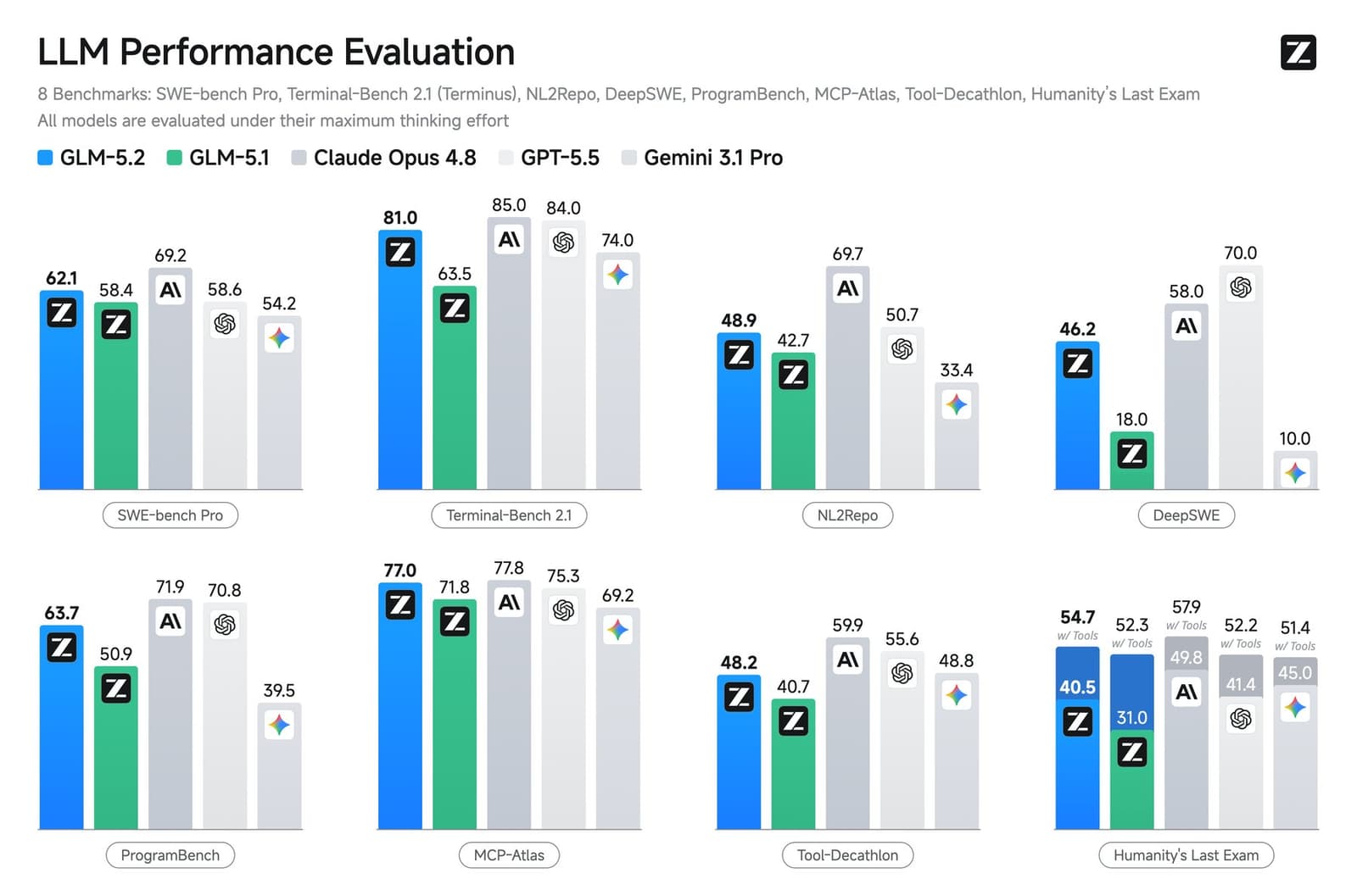
GLM‑5.2 is Zhipu AI’s latest large language model, released under the MIT license. The most eye‑catching technical spec is its stable one‑million‑token context window, which lets the model keep an entire project’s source files in memory during a single prompt. In a coding marathon benchmark called FrontierSWE—designed to measure how well models tackle hours‑long software‑engineering tasks—GLM‑5.2 finished just one percentage point behind Anthropic’s Claude Opus 4.8, the current closed‑source leader. The model’s performance on pure reasoning tests, however, remains noticeably lower than those proprietary rivals.
According to The Decoder, the model’s open‑source status and massive context length make it a rare combination in the current AI ecosystem.
Source: The Decoder
Best Use Cases
Large‑scale code reviews and refactoring. The million‑token window means you can feed an entire repository to the model and ask for architectural suggestions, dependency analysis, or bulk style fixes without chopping the code into tiny snippets.
Extended coding marathons. Teams that compete in or simulate long‑duration software‑engineering challenges can use GLM‑5.2 as a teammate. Its FrontierSWE results show it can stay productive over many hours, delivering solutions that are only marginally behind the best closed‑source agents.
Open‑source projects that need a permissive license. Because GLM‑5.2 is MIT‑licensed, developers can embed it in tools, services, or even commercial products without the legal overhead that accompanies many proprietary APIs.
Limits
While GLM‑5.2 shines in sustained coding tasks, its reasoning abilities lag behind closed‑source competitors. For problems that require deep logical inference, multi‑step planning, or abstract problem solving outside of pure code generation, the model may produce less reliable outputs.
The benchmark mentioned in the source focuses on a specific coding marathon suite; performance on other programming‑related benchmarks (e.g., unit‑test generation, bug fixing, or natural‑language documentation) is not detailed. Potential adopters should therefore test the model on their own target tasks before committing.
No pricing information was disclosed, and the source does not list hardware requirements. As with most large models, expect a need for substantial GPU memory to exploit the full context length.
Alternatives
The most direct competitor cited is Anthropic’s Claude Opus 4.8, which still holds a one‑point edge on FrontierSWE and leads on reasoning benchmarks. Claude Opus is a closed‑source service, meaning users must accept API costs and licensing restrictions.
For teams unwilling to rely on a proprietary provider, other open‑source coding models exist, but the source does not provide comparative data. GLM‑5.2’s combination of a million‑token context and near‑leader performance makes it the most advanced open‑source option highlighted in the available reporting.
Final Recommendation
GLM‑5.2 is a solid choice for developers who prioritize a very long context window, open licensing, and strong marathon‑coding performance. It is especially appealing for large codebases, open‑source tooling, and teams that want to avoid vendor lock‑in. If your workflow leans heavily on complex reasoning or you need the absolute top performance on every coding benchmark, you may still want to keep a closed‑source service like Claude Opus in the mix.
📎 Related Articles
Salt Code Review: Enforcing Security in AI Coding Assistants • Niteshift AI Coding Startup: Who Should Try It? • Lovable AI Coding Startup: Is It Worth Your Attention? • Virgin Atlantic’s Codex‑Powered Sprint Beats Traditional Code Review • Virgin Atlantic vs. Rivals: Who Gains More Speed from Codex? • Virgin Atlantic ships faster with Codex – a head‑to‑head look at enterprise AI coding agents • SpaceX’s $60B Cursor Deal: Should Developers Jump In? • Mirage Video Model Review: When Spatial Memory Matters
Explore related AI topics
AI News Today • AI Tools • Best AI Tools • ChatGPT Prompts • AI Agents