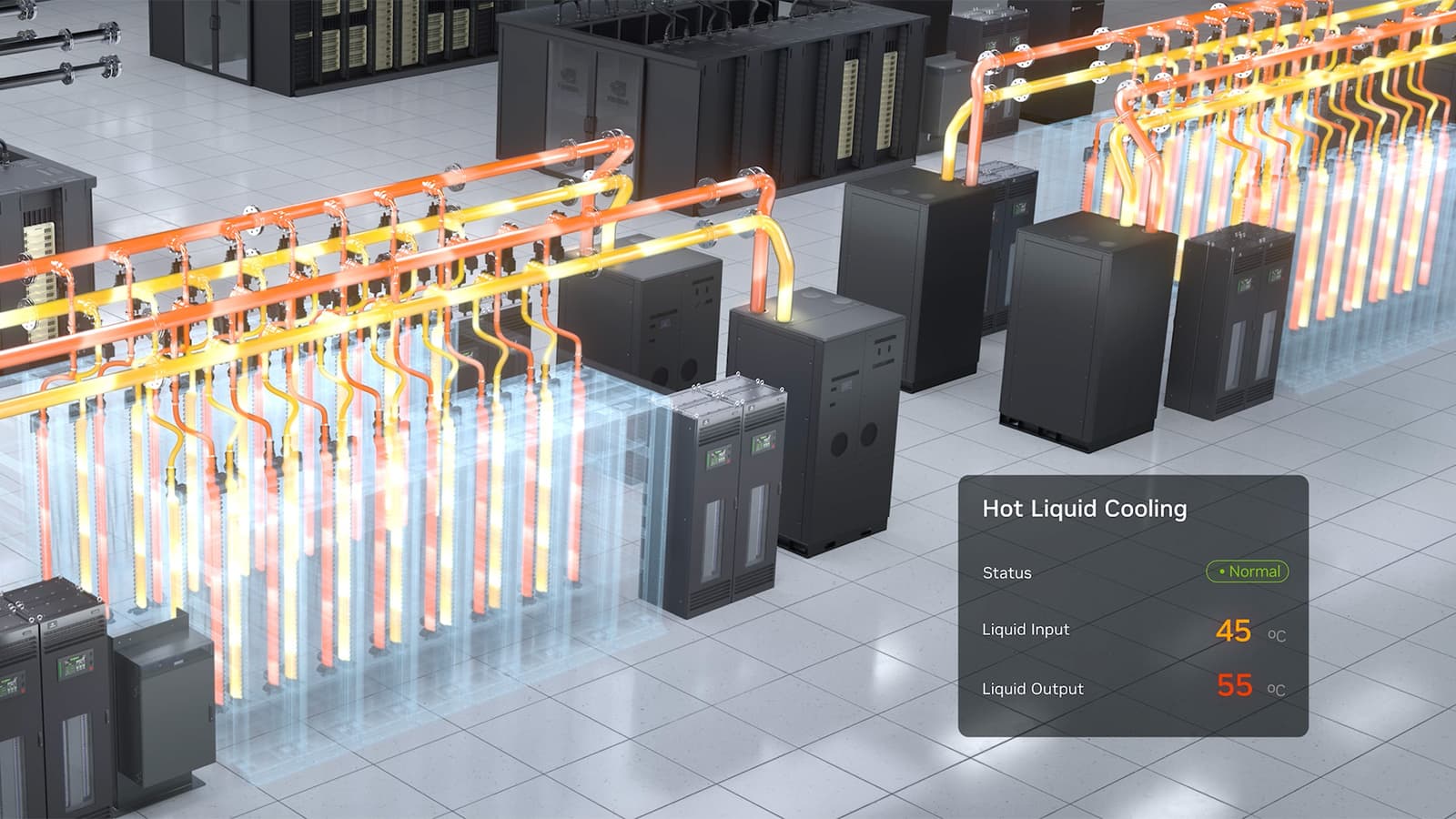
NVIDIA announced on June 22 that its newest AI servers can circulate liquid‑coolant at 45 °C, a temperature hotter than a typical hot tub, unlocking new energy savings for the world’s largest machine‑learning models.
Context
Data‑center operators have long relied on chilled water loops kept near 38 °C (the temperature of most hot tubs) to keep GPUs and custom ASICs from overheating. The new NVIDIA design pushes that limit to 45 °C (113 °F), according to the company’s official blog. Running coolant at a higher temperature reduces the load on chillers, which are among the biggest electricity draws in a high‑performance computing facility.
At the same time, the AI hardware market is seeing massive capital inflows. Google, for example, disclosed a $1.5 billion investment for 2026‑27 to expand its Jackson County, Alabama data‑center campus, underscoring the industry’s appetite for more compute capacity. As AI workloads grow, every watt saved on cooling translates into lower operating expenses and a smaller carbon footprint.
Impact
The higher coolant temperature is “precisely what makes them more energy efficient,” NVIDIA explained, because chillers can operate at reduced capacity or be replaced with smaller units. For operators running dozens of racks, the cumulative power reduction can be significant, though NVIDIA did not publish exact percentages.
Beyond cost, the breakthrough opens the door to denser server configurations. With less aggressive cooling, racks can be placed closer together, freeing floor space for additional hardware. Facilities in warmer climates, which previously needed extensive air‑conditioning, may now host high‑end AI clusters without major retrofits.
Environmental advocates note that cutting chiller electricity demand also reduces the need for refrigerants, a known source of greenhouse‑gas emissions. While the cooling improvement alone will not solve AI’s overall energy concerns, it is a measurable step toward more sustainable large‑scale training.
What’s Next
NVIDIA plans to integrate the 45 °C liquid‑cooling technology into its DGX Cloud offerings and partner data‑center deployments over the coming months. Early adopters are expected to be cloud providers and research institutions that already run large language models or generative‑AI workloads.
Industry observers suggest that other hardware vendors may follow suit, exploring higher‑temperature coolant loops or alternative cooling fluids. As AI compute demand continues to rise, the pressure to squeeze more performance out of each kilowatt will keep driving innovations in thermal management.
For now, the 45 °C breakthrough gives data‑center owners a concrete lever to trim electricity bills while keeping the world’s biggest AI models humming.
📎 Related Articles
Taiwan Powers Global AI Buildout with NVIDIA's Vera Rubin • Eco Wave Power Boosts Wave Energy with NVIDIA AI and Digital Twins • NVIDIA Partners Deploy AI at Cannes Lions, Raising Cost Stakes • FERC Grants AI Data Centers Priority Grid Access • NVIDIA Blackwell Sets New MLPerf Training Records • How NVIDIA’s AI Factory Could Slash LG’s Compute Costs • NVIDIA Blackwell Ultra Sets New Power‑Efficiency Standard for Agentic AI • Meta and Reliance Launch 168‑MW AI Data Center in India
Explore related AI topics