Verdict
If you run large numbers of autonomous AI agents and care about power bills, the Blackwell Ultra NVL72 platform is worth a serious look. If your workloads are small‑scale, single‑agent or you lack the budget for a new data‑center class system, waiting for broader software support may be wiser.
What It Does
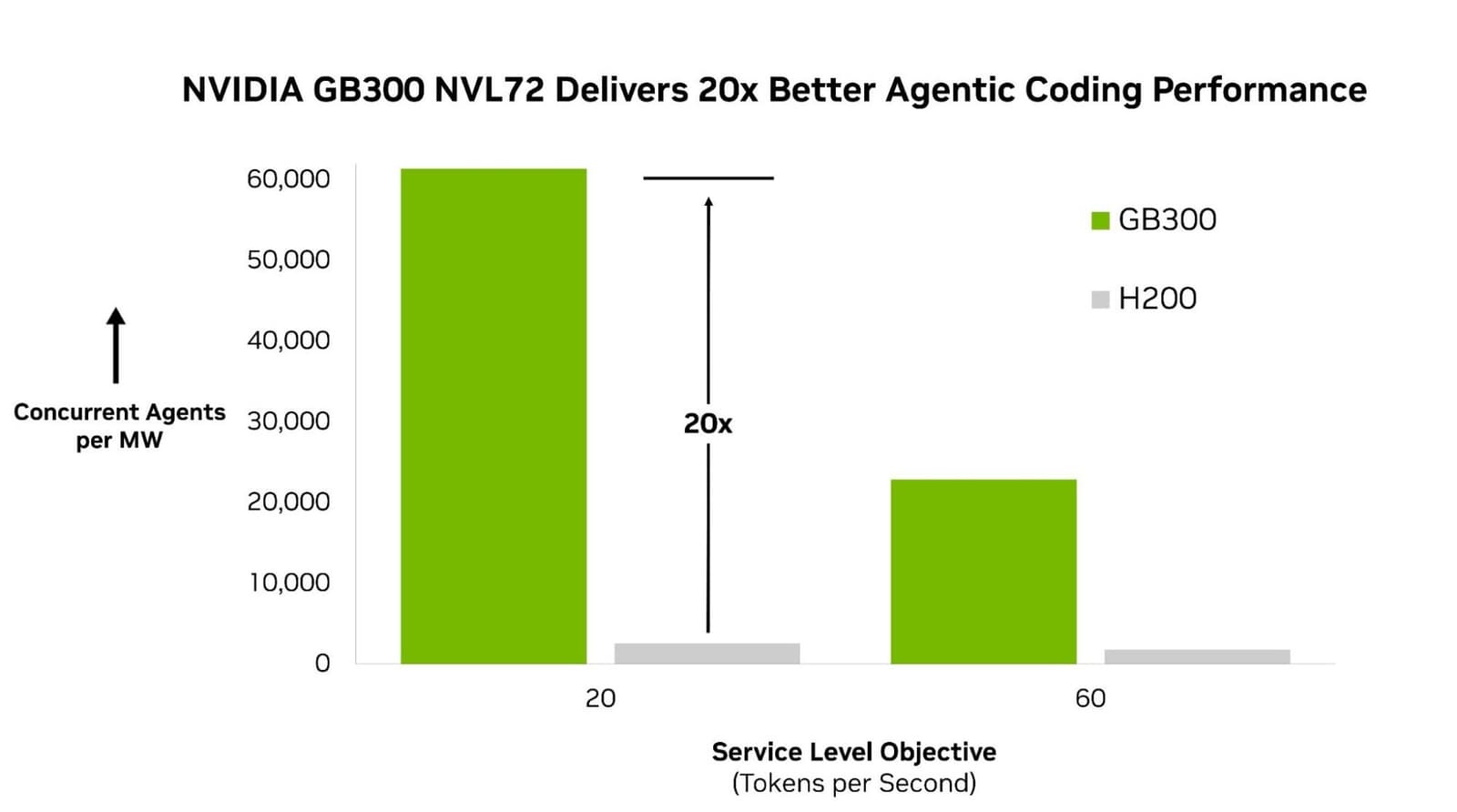
AgentPerf, the industry’s first benchmark for agentic AI, measures how many AI agents a system can sustain per unit of electricity. In the inaugural release, NVIDIA’s Blackwell Ultra NVL72 scored the highest, running roughly twenty times more agents per megawatt than other NVIDIA offerings cited in the same test. The benchmark focuses on workloads where many agents act concurrently—think chat assistants, autonomous decision‑makers, or simulation fleets.
Best Use Cases
- High‑density AI services: Companies that host thousands of conversational bots or real‑time decision agents can squeeze more work into each kilowatt, reducing overall energy spend.
- Research clusters: Universities and labs that run massive multi‑agent simulations—such as climate models or distributed reinforcement‑learning experiments—gain both speed and cost efficiency.
- Enterprise AI platforms: Firms building internal toolchains that spin up many short‑lived agents for data processing or workflow automation benefit from the power‑per‑agent advantage.
Limits
The data comes from the first round of AgentPerf results, so the comparison set is still narrow. NVIDIA’s own platforms dominate the published list, leaving open questions about how non‑NVIDIA hardware would compare. No pricing information is disclosed, so total cost of ownership must be estimated from power consumption alone. Finally, the benchmark stresses agent count, not necessarily latency or model accuracy, which may matter for latency‑sensitive applications.
Alternatives
For teams that cannot adopt Blackwell Ultra immediately, NVIDIA offers other hardware that can run agentic workloads, albeit with lower power efficiency. The RTX PRO line and DGX Spark systems have been tuned for fast text generation models like DiffusionGemma, an open model from Google DeepMind that generates whole blocks of text in parallel (NVIDIA Newsroom, 2026‑06‑10). These platforms work well for single‑user or low‑agent scenarios where latency matters more than raw agent density.
Outside the NVIDIA ecosystem, OpenAI’s Codex has been applied to scientific simulation tasks, such as black‑hole modeling by astrophysicist Chi‑kwan Chan (OpenAI Blog, 2026‑06‑11). While Codex excels at code generation rather than massive agent deployment, it illustrates that specialized models can still deliver value without the need for a high‑density agentic infrastructure.
Final Recommendation
Based on the AgentPerf numbers, Blackwell Ultra NVL72 offers a clear power‑efficiency edge for workloads that depend on running many agents at once. Organizations with power‑constrained data centers or cloud‑scale AI services should prioritize evaluating Blackwell Ultra, keeping an eye on upcoming software stacks and pricing. Smaller teams or those focused on single‑agent tasks can start with RTX PRO or DGX Spark, and consider Blackwell Ultra as the next step when scaling becomes a priority.
📎 Related Articles
NVIDIA, Foxconn & Taiwan Med Centers Deploy Agentic AI for Health • AgentOps Review: Managing Agentic AI with Amazon Bedrock AgentCore • NVIDIA’s Open‑Source Agent Stack: Who Benefits and Who Should Pass • Rocket Close’s Agentic AI Boost for Title Operations • Amazon Honors ASU Researcher: What It Means for Agentic AI Security • Why Enterprises Must Redesign for Agentic AI • Google Search Agents Now Support Every AI Mode Language for Ultra Users • Agentic AI in Finance: Who Should Deploy It and Who Should Wait
Explore related AI topics
AI News Today • AI Tools • Best AI Tools • ChatGPT Prompts • AI Agents