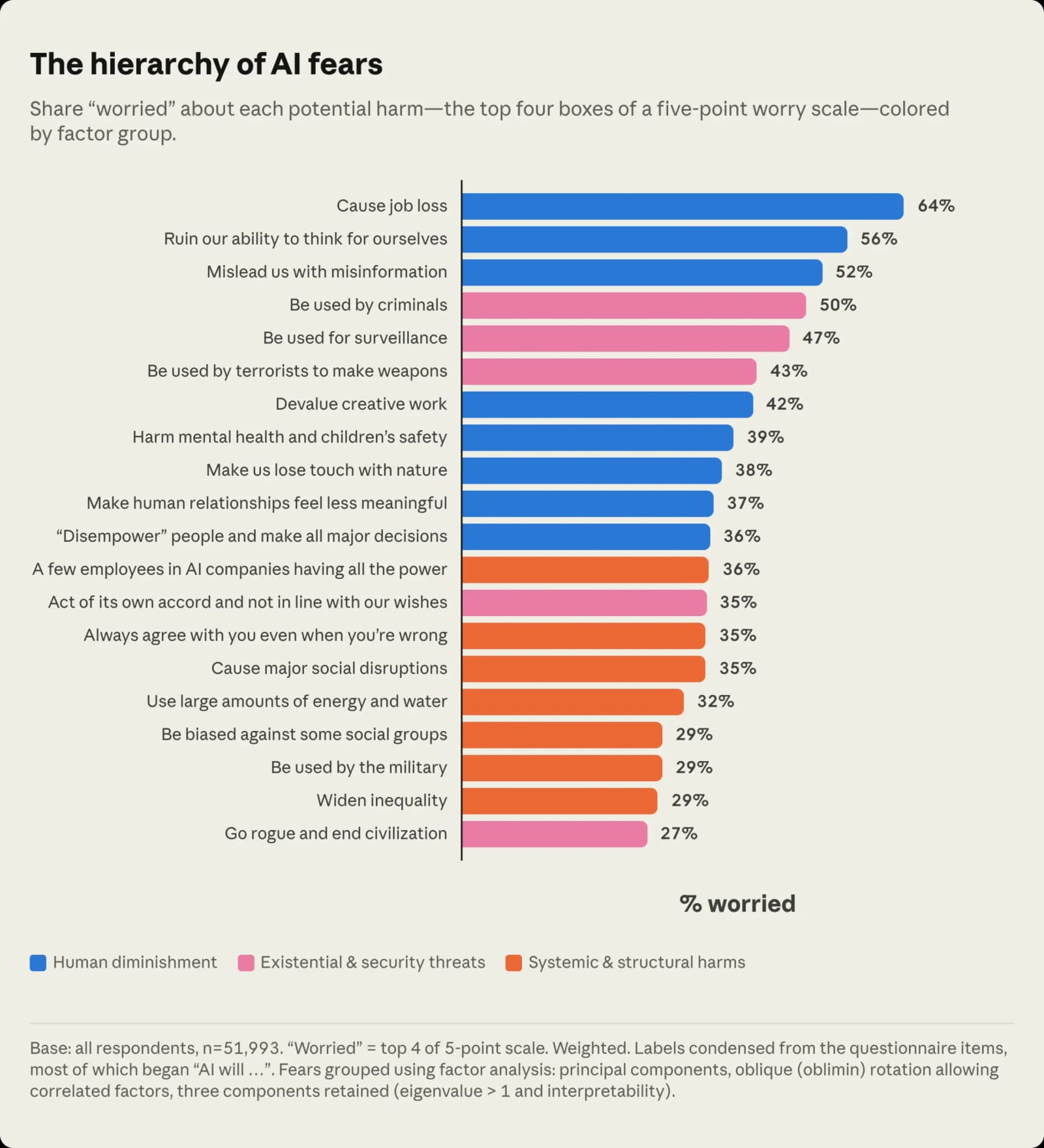
Sixty‑four percent of Americans say they fear AI will take their jobs, and 56 percent worry it will erode their ability to think for themselves, according to a nationwide survey released on June 12, 2026.
The poll, conducted by Anthropic, asked nearly 52,000 U.S. adults about their hopes and anxieties surrounding artificial intelligence. Respondents were split by usage patterns: daily AI users expressed markedly less concern, while the broader public voiced strong apprehension about both employment security and cognitive autonomy.
Context behind the numbers
Anthropic’s questionnaire covered a range of scenarios, from AI‑assisted writing to fully autonomous decision‑making tools. While the exact breakdown of demographic groups was not disclosed, the sheer sample size—over fifty‑two thousand participants—lends weight to the findings. The survey also revealed a paradox: even when respondents acknowledged that AI could handle specific tasks, most still rejected its deployment in their own workplace.
These attitudes emerge amid a wave of high‑profile AI rollouts. On the same day the survey was published, Meta announced a donation program delivering Ray‑Ban Meta smart glasses to every blind veteran in the United States, a move that showcases AI’s potential to enhance daily life for specific communities. Meanwhile, industry analysts noted that vendors are embedding “agentic” AI into products, a development that is driving cost volatility across the sector. In the health arena, a separate report highlighted that many AI‑driven medical tools operate without the oversight many expect, raising questions about safety and accountability.
Impact on the workforce and public discourse
The fear of job displacement is not new, but the coupling of that anxiety with concerns about mental independence marks a shift in public sentiment. When 64 % of respondents cite job loss as a top worry, employers and policymakers can no longer treat automation as a purely technical challenge. The additional 56 % who fear a loss of independent thinking suggest that the perceived threat extends beyond economics into personal identity.
Corporate leaders may interpret the reluctance to adopt AI at the employee level as a signal to prioritize transparent deployment strategies. The survey’s finding that daily AI users are less fearful indicates that familiarity breeds confidence, hinting that broader education could mitigate some of the alarm. However, the prevailing rejection of AI in one’s own workplace—even for tasks deemed suitable—signals a deeper trust gap that could slow adoption rates.
From a policy perspective, the data aligns with growing calls for clearer regulation of AI systems. The health‑AI oversight article underscores that many algorithms operate without the scrutiny traditionally applied to medical devices, a situation that could exacerbate public fears if left unchecked. Legislators may look to these survey results as evidence that Americans expect stronger safeguards before AI becomes embedded in critical sectors.
What comes next?
Anthropic’s findings are likely to fuel further research into the social dimensions of AI. Follow‑up surveys could track whether exposure to AI tools—like the smart glasses being distributed to blind veterans—shifts public opinion over time. Industry analysts will watch how the cost fluctuations of agentic AI products affect adoption, especially if price pressures force companies to accelerate deployment despite employee resistance.
On the regulatory front, the dual concerns of employment and cognitive autonomy may prompt new legislative proposals aimed at protecting both jobs and mental agency. Proposals could include requirements for human‑in‑the‑loop decision making, transparent algorithmic explanations, and retraining programs for workers whose roles are most vulnerable to automation.
For now, the survey serves as a barometer of American unease at a moment when AI is moving from experimental labs into everyday life. Whether that anxiety translates into concrete action—be it corporate policy shifts, educational initiatives, or legislative measures—remains to be seen. What is clear is that any future rollout of AI technology will need to address not just efficiency gains, but also the very real fear that it could undermine the work and thought that define many Americans’ sense of self.
📎 Related Articles
Walmart assures staff AI will aid, not replace jobs • AI Mode reshapes how Americans search • Google Workspace adds voice, AI Inbox, and Google Pics • Google I/O 2026 rolls out 100 new tools and services • New $10K AI & Robotics Investment Guide Hits Market • Meta Gives Free AI Glasses to Every Blind Veteran in the U.S. • NAVER scales AI infrastructure to 55 MW, eyes gigawatt future • Maryland Opens AI Innovation Lab to Accelerate State Tech
Explore related AI topics
AI News Today • AI Agents • AI Models • AI Coding Tools • AI Video Tools • Gemini vs ChatGPT • Open Source AI Models