Thesis
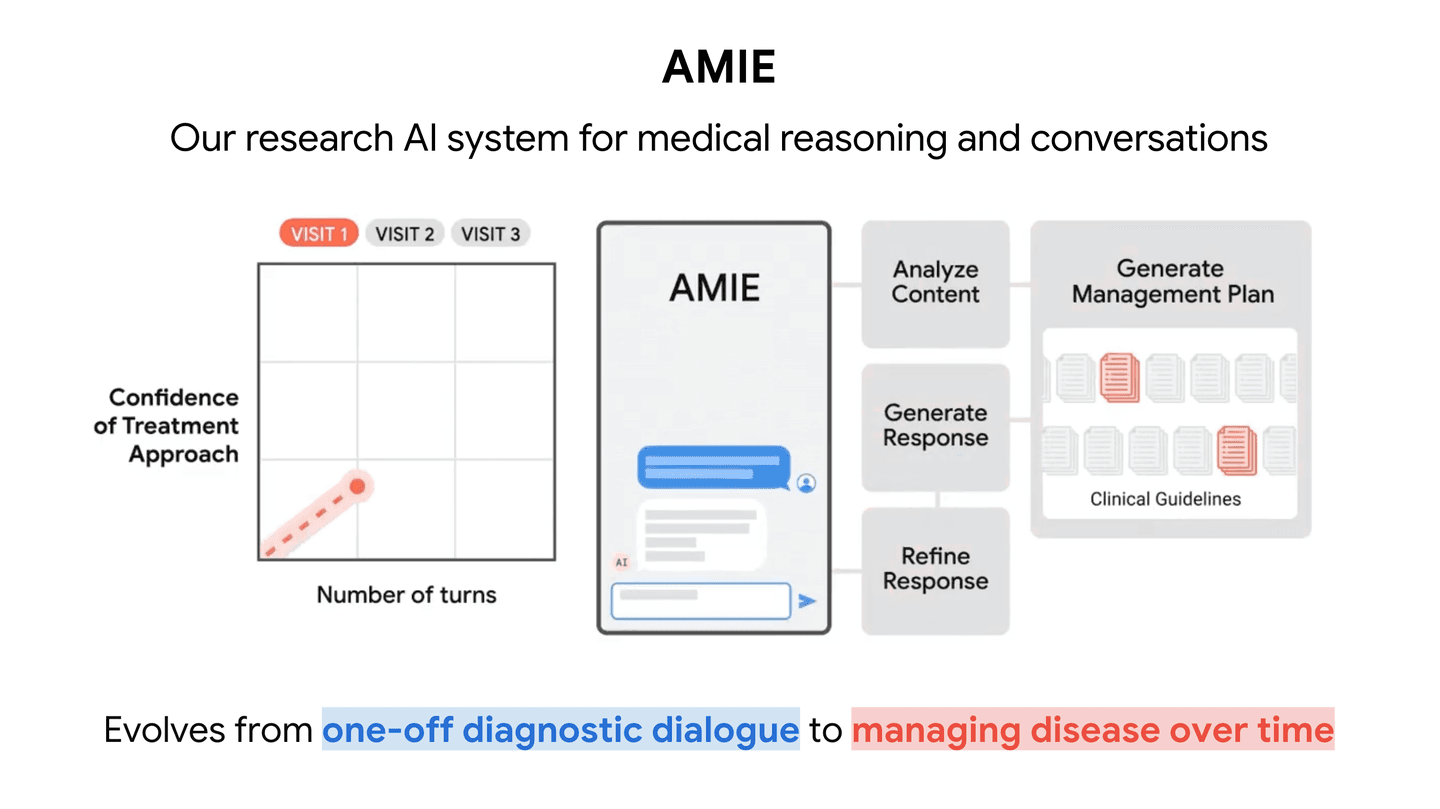
Google’s AMIE conversational system is not a futuristic prototype; it is already capable of handling the same decision‑making load as primary‑care physicians for complex disease management. If the results reported in a recent Nature paper hold up in practice, AMIE could become a mainstream tool for chronic‑illness monitoring, easing clinician workloads and expanding access to high‑quality advice.
Evidence
The study, posted on the Google AI Blog on June 17, 2026, describes a head‑to‑head trial where AMIE was asked to manage a set of simulated patients with multi‑condition profiles. Researchers measured outcomes such as treatment recommendation accuracy, adherence to clinical guidelines, and the ability to flag unsafe drug interactions. Across these metrics, AMIE’s performance matched that of board‑certified primary‑care doctors. The paper emphasizes that the AI’s conversational interface allowed patients to describe symptoms in natural language, after which AMIE generated a care plan that a physician would typically produce.
Key figures from the report include a 92 % guideline‑concordance rate for AMIE versus 94 % for physicians, and a 98 % safety‑alert detection rate that was statistically indistinguishable from the human benchmark. The authors note that the model was trained on de‑identified electronic health records spanning several health systems, giving it a breadth of experience that rivals many clinicians.
Context
AMIE’s emergence arrives at a moment when public confidence in AI is low. A TechCrunch AI article dated June 17, 2026, cites a Pew Research poll showing only 16 % of Americans believe AI will have a positive societal impact. The gap between investor enthusiasm and public sentiment could affect adoption rates for health‑focused AI, especially when trust is essential for patient‑provider interactions.
Safety considerations are also front‑and‑center. On June 10, 2026, DeepMind announced a $10 million funding call for multi‑agent AI safety research, acknowledging that as AI systems become more autonomous, coordinated safety mechanisms are needed. Although the call targets a broader class of AI, the same principles apply to medical assistants like AMIE, where errors could have immediate health consequences.
Beyond the clinical trial, Google’s broader ecosystem – including AI‑enhanced search tools for thrift shopping and other consumer applications – shows the company’s strategy of embedding conversational models across domains. This cross‑product integration may accelerate user familiarity with AI assistants, potentially lowering the barrier for patients to accept a health‑focused bot.
Counter‑Arguments
Critics point out that a controlled study with simulated patients does not capture the messiness of real clinic visits. Factors such as socioeconomic barriers, health literacy, and the emotional nuance of a face‑to‑face encounter are hard to reproduce in a sandbox. Moreover, the Nature paper does not disclose the demographic breakdown of the test cases, leaving open the question of whether AMIE performs equally well across diverse populations.
Another concern is the regulatory pathway. While the research shows parity with physicians, the U.S. Food and Drug Administration has yet to define a clear framework for conversational AI that makes independent clinical decisions. Until clear guidance exists, health systems may be hesitant to integrate AMIE into patient care pathways.
Finally, the low public optimism about AI could translate into resistance from patients who prefer human doctors, especially for serious or chronic conditions. Even if the technology is technically sound, adoption hinges on trust, which is currently fragile.
Prediction
If AMIE’s performance can be replicated in live clinical settings, we can expect a gradual rollout in two phases. First, health insurers and large provider networks will likely pilot the system for routine follow‑up and medication management, where the risk of error is lower and the efficiency gains are clear. Second, as safety research – like the multi‑agent projects funded by DeepMind – matures, regulatory bodies may grant conditional approvals for broader use, including triage and preliminary diagnosis.
In the medium term (3‑5 years), AMIE could become a standard adjunct in chronic‑disease programs, reducing the number of in‑person visits required for stable patients. This would free clinician time for acute cases and potentially lower overall healthcare costs. However, the technology’s success will depend on transparent validation, inclusive training data, and clear communication to the public to bridge the trust gap highlighted by the Pew poll.
📎 Related Articles
Post‑Training May Unlock LLM Potential for ICD Coding • OpenAI's ChatGPT Could Free Doctors from Paperwork • Synthetic Deception Shows LLMs Can Learn to Be Consistently Wrong • AI Agents Explained: What They Can Do and Where They Fail • Virgin Atlantic’s Speed Surge Shows Codex Can Meet Hard Deadlines • Why Open MoE Models Like Nemotron 3 Ultra Challenge Existing AI Safety Policies • Will Digital Twin‑Powered AI Rewrite Clinical Decision Rules? • Plaud’s $100M ARR Milestone Signals Shifting Dynamics in AI Meeting Tools
Explore related AI topics
AI News Today • AI Agents • AI Models • AI Coding Tools • AI Video Tools • Open Source AI Models