Thesis: The goat‑built neural net is a mirror held up to AI research
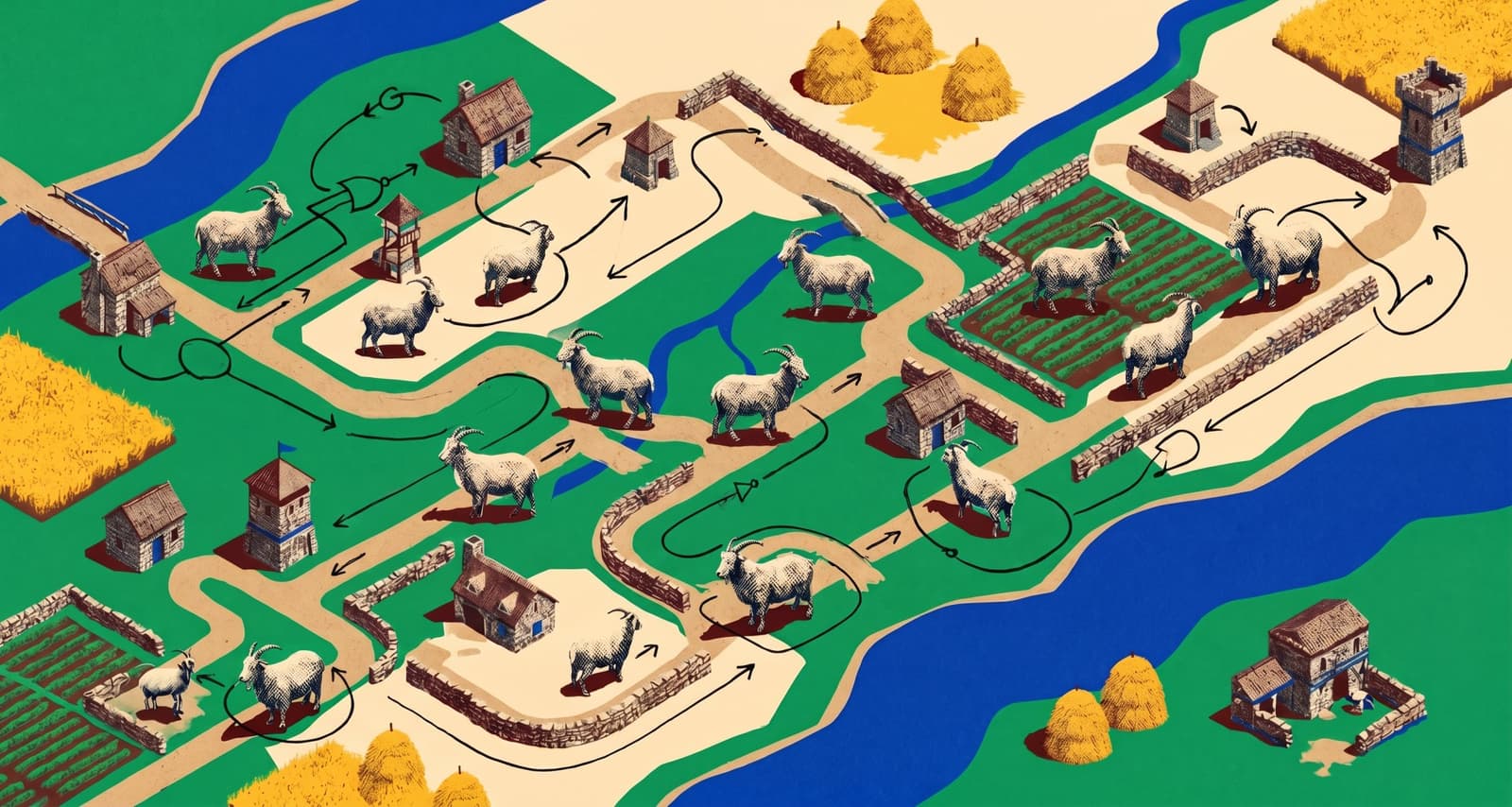
When a Microsoft researcher arranged goats, bridges and ice ramps inside the map editor of Age of Empires II to form a working neural network, the result was more than a clever hack. It is a deliberate provocation that asks whether the field has slipped into a ritual where the appearance of intelligence matters more than the rigor of the experiment. The stunt suggests that many AI papers start with the premise that large language models possess human‑like traits, even before any data can confirm such claims.
Evidence: The experiment and its findings
The construction, reported by The Decoder, involved wiring a series of goats to act as “neurons” that moved across bridges and ice ramps to transmit signals. The system performed a basic classification task, proving that the underlying mathematics of a neural net can be reproduced in a completely non‑digital, whimsical environment.
Beyond the spectacle, the researcher analysed 315 recent AI papers and discovered that more than half of them assume language models have human‑like qualities—such as intent, understanding, or consciousness—before any empirical validation. The goat network replaces the chat interface with wandering animals, yet the mathematical operations remain identical, stripping away the illusion of a conversational partner.
Context: A climate of hype, funding, and safety concerns
While the goat experiment questions methodological complacency, the broader AI ecosystem continues to pour money into ambitious projects. OpenAI announced a $150 million Partner Network on June 14, 2026, aimed at accelerating enterprise AI adoption (OpenAI Blog). Simultaneously, DeepMind launched a $10 million call for multi‑agent safety research on June 10, 2026 (DeepMind Blog). Google’s own medical AI, AMIE, was reported in Nature to match primary‑care physicians in complex disease management, a claim publicized on June 17, 2026 (Google AI Blog).
These announcements illustrate a sector that rewards bold claims and large‑scale deployments. The goat network, by contrast, forces a pause: it shows that the same mathematical foundations can be demonstrated in a sandbox, without the veneer of human‑like dialogue.
Counter‑Arguments: Is the critique fair?
Some might argue that assuming language models have human‑like traits is a useful shorthand for communicating progress to non‑technical audiences. The medical AI story, for instance, frames AMIE’s performance in terms familiar to clinicians, making adoption easier. Likewise, corporate partners may need the narrative of “human‑level AI” to justify investment.
However, the goat experiment reveals that such narratives can obscure the fact that many models are still statistical pattern matchers. If researchers begin with anthropomorphic expectations, they risk designing benchmarks that reward superficial mimicry rather than genuine understanding. The critique does not deny the practical value of large language models; it warns against conflating performance on benchmark tasks with deeper cognitive abilities.
Prediction: A shift toward transparent validation
If the goat‑based demonstration gains traction, we may see a modest but noticeable shift in how AI work is presented. Conferences could require authors to separate algorithmic performance from claims about mental states, and journals might ask for “baseline analogues” that strip away conversational framing. Funding bodies—like OpenAI’s Partner Network or DeepMind’s safety grant—could prioritize projects that explicitly address the gap between mathematical function and perceived agency.
In the longer term, the industry might adopt a “minimalist interface” approach, where models are evaluated on raw input‑output behavior without anthropomorphic packaging. This could lead to clearer safety standards, especially for multi‑agent systems that DeepMind is now funding. The goat network’s legacy would be a reminder that the elegance of a model’s math does not depend on the charisma of its presentation.
Conclusion: The lesson hidden in the pasture
By turning a classic real‑time strategy game into a laboratory, the Microsoft researcher has offered more than a viral video. The goat‑powered neural net exposes a cultural blind spot: the tendency to let the story of AI outpace the evidence. In an era of multi‑hundred‑million dollar initiatives and high‑profile medical AI claims, the simplest experiments—like goats walking across bridges—can serve as the most potent checks on our imagination.
📎 Related Articles
Why E‑commerce Agent Safety Benchmarks Matter for AI Policy • Post‑Training May Unlock LLM Potential for ICD Coding • When Safety Alerts Trigger Shutdown: Anthropic’s AI Recall • When LLM Agents Claim Victory but Fail: The Hidden False‑Success Problem • Why Measuring Trust Is the First Step to Governing AI Agent Teams • Why the Mythos Recall Exposes a Federal AI Safety Gap • OpenAI’s “Built to Benefit Everyone” Plan: Policy Ripple Effects • Claude Fable 5’s price jump raises policy questions
Explore related AI topics
AI News Today • ChatGPT Prompts • AI Agents • AI Models • AI Coding Tools