Thesis
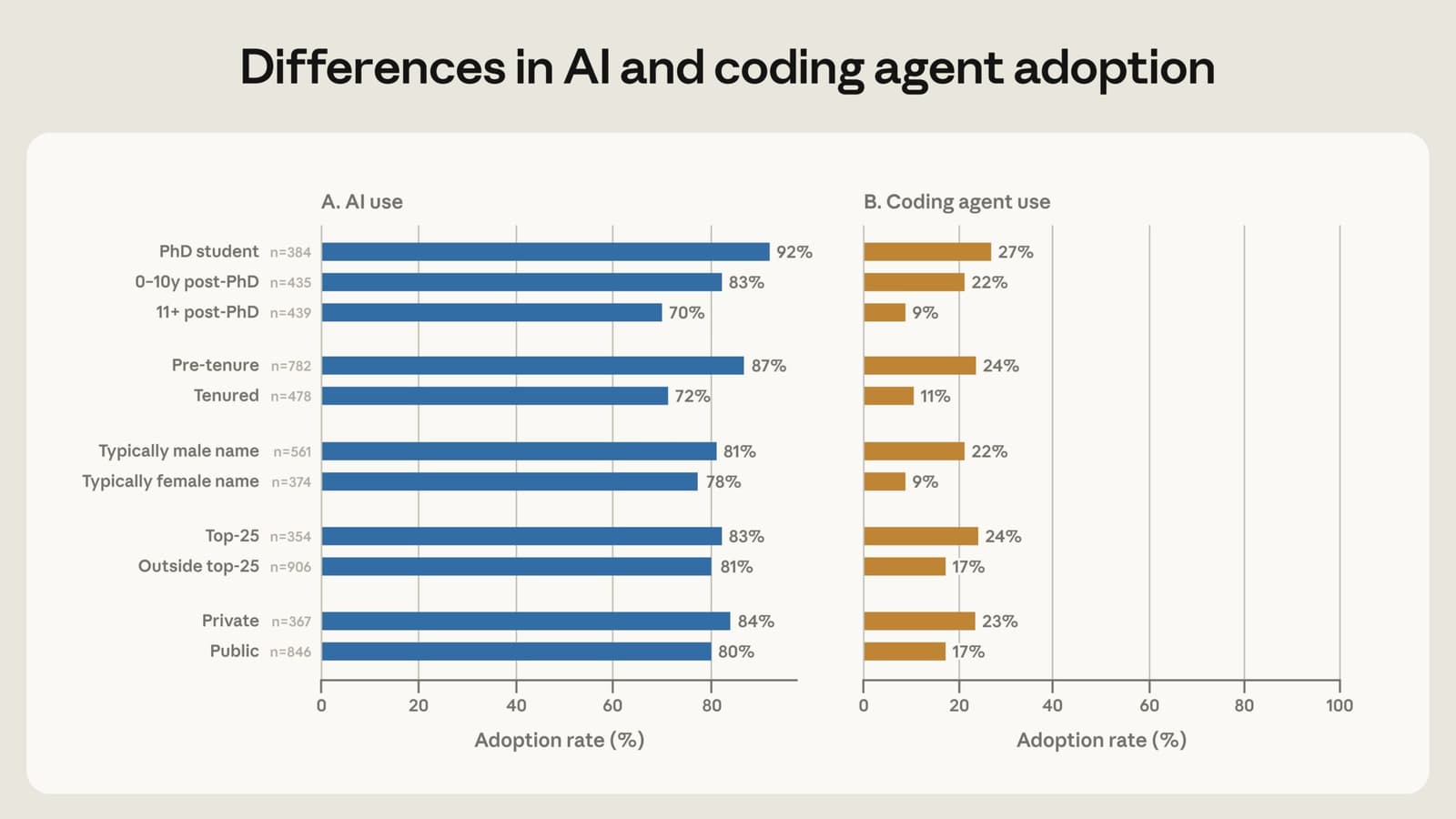
Men are shaping the future of social‑science research not by publishing more papers, but by reaching for AI coding agents twice as often as their female peers. The disparity is not a marginal curiosity; it points to a workflow divide that could reshape how knowledge is built.
Evidence
According to The Decoder, researchers whose names are typically male invoked AI coding agents more than two‑fold compared with researchers whose names are typically female. The gap held steady even when the analysis controlled for discipline and career stage. Economists topped the usage chart at 39 percent, while education scholars lagged at just four percent. The study also noted that the gender gap for coding agents dwarfs the gap for general AI tools.
Context
AI coding agents—software that translates natural‑language prompts into executable code—have become a staple for data‑heavy projects. In a field that increasingly relies on large‑scale surveys, text mining, and simulation, the ability to generate scripts on demand can cut weeks of manual coding into minutes. Researchers who embed these agents into their daily workflow gain a speed advantage that translates into more experiments, faster iteration, and, ultimately, a larger publication pipeline.
The same report highlights that the gap is not limited to a single subfield. While economists lead at 39 percent, other domains such as education sit at a modest four percent. This spread suggests that the gender gap is systemic, not an artifact of one discipline’s culture.
Practical Builder Workflow
Consider a typical research project that starts with a hypothesis, moves through data acquisition, cleaning, analysis, and finishes with a write‑up. An AI coding agent can be summoned at three critical junctures:
- Data wrangling. A prompt like “clean missing values in a panel dataset and generate summary statistics” yields a ready‑to‑run script.
- Model specification. Researchers can ask the agent to build a regression, a difference‑in‑differences estimator, or a machine‑learning classifier without hand‑coding each line.
- Visualization. A natural‑language request for “plot the interaction effect with confidence bands” produces publication‑ready graphics.
When a researcher routinely taps the agent at each stage, the cumulative time saved can be dramatic. The Anthropic data implies that men are more likely to embed this loop, turning the agent into a virtual research assistant. Women, by contrast, appear to rely more on traditional scripting or manual coding, which can extend project timelines.
Why the Gap Exists
The study does not diagnose causality, but several plausible explanations emerge from the numbers. First, the gender gap for coding agents is “far wider than for general AI use,” indicating that the barrier is not a lack of awareness about AI itself. Instead, the obstacle seems tied to confidence or familiarity with code‑generation tools.
Second, discipline‑level differences hint at cultural factors. Economics, a field historically dominated by men, shows the highest adoption rate. Education, where women are the majority, records the lowest. The pattern suggests that departmental norms and mentorship may influence whether a researcher feels comfortable delegating code to an algorithm.
Counter‑Arguments
Critics might argue that the study’s reliance on name‑based gender inference inflates the gap. A name does not always map neatly onto gender identity, and some researchers may use initials or non‑binary identifiers that the analysis could miss.
Another objection could be that the observed usage disparity reflects differences in research topics rather than gender per se. If men are more likely to pursue data‑intensive projects that demand heavy coding, they would naturally turn to agents more often.
Finally, some may contend that the gap is temporary. As AI coding agents become more embedded in curricula and institutional training, women may catch up, narrowing the disparity.
Prediction
If the current trajectory continues, the gender gap in AI‑assisted coding will widen the productivity chasm between male and female social‑science researchers. Institutions that ignore the gap risk amplifying existing inequities in grant success, citation counts, and career advancement.
Conversely, targeted interventions—such as workshops that pair women with coding‑agent mentors, or departmental incentives for agent‑based workflow adoption—could invert the trend. By the end of the decade, we may see a more balanced usage pattern, provided that the community treats the gap as a technical, not a cultural, problem.
What Researchers Can Do Now
1. Audit your own workflow. Track how often you invoke a coding agent versus manual scripting.
2. Share prompts and successful scripts in lab meetings. Peer learning reduces the intimidation factor.
3. Request formal training from your institution’s data‑science office. Structured sessions demystify the agent’s capabilities.
4. Document any gender‑related barriers you encounter. Data drives policy, and a clear record can motivate change.
📎 Related Articles
Why OpenAI’s Coding Agents Earn Gartner’s Top Spot • Why a Growing Test Suite is Essential for Bedrock Agents • Cognition’s Devin AI Agent Aims to Assist, Not Replace Programmers • OpenAI Leads Enterprise Coding Agents and Expands AI Reach • Why Permissions, Not Model Power, Are Holding AI Agents Back • Virgin Atlantic ships faster with Codex – a head‑to‑head look at enterprise AI coding agents • Local AI Agents on Nvidia‑Powered PCs Could Trim Cloud Bills • Critical Open‑Source Flaw Threatens Millions of AI Agents